Non-surgical management of angular limb deformities in foals

Abstract
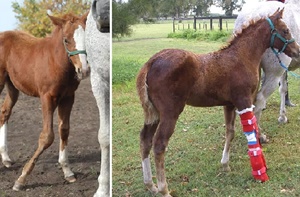
The balance of the horse corresponds to the orientation of the limbs under the body. The young foal can be confronted a few days after its birth or during its growth with limb deformities causing a bad distribution of the loads, an uneven wear on the level of the joints, the muscles and the ligaments. These deviations are at the origin of pathologies such as osteochondrosis, osteoarthritis, tendonitis or fractures, likely to influence his performance and his career thereafter. These deformities mainly concern the carpal, fetlock and hock joints. In congenital deviations, they are attributed to immaturity of the bone structure, laxity of the peri-articular structures, asynchronous bone growth or diaphyseal deviation. In the case of acquired deviations, the disproportionate bone growth of the growth plates and the ossification centers of the epiphyses are responsible. The treatment of these deviations must be before the closure of the foal's growth plates. Various treatments are currently available to correct these deviations, they are conservative measures, farriery or surgical interventions. The purpose of this bibliographic update is to list the various non-surgical treatments currently described and to compare their results, in order to guarantee equine veterinary practitioners and veterinary students the best therapeutic management of the pathology.
Keywords: angular deviations, treatment, valgus, varus, foal