Evolution of forest cover in the Pay-Kongila sector, Masi-Manimba territory, Kwilu province (DRC)

Abstract
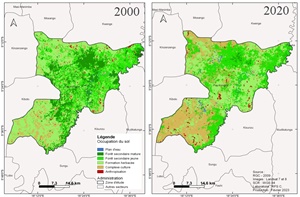
The study focused on the evolution of the forest cover of the Pay-Kongila Sector in the territory of Masi-Manimba in the province of Kwilu, Democratic Republic of Congo (DRC). The study area thus defined fits well into the Kasai phytogeographic sector, regional center of Guinea-Congolese endemism. The overall objective of this work was to understand the direction of the evolution of the forest cover (progression or regression) over the period from 2000 to 2020, with an objective for actions likely to mitigate the effects and causes which could be the cause. Specifically, this study aims to (1) map the forest cover of the Pay –Kongila Sector, (2) determine the areas of land use classes at the interval of 2000 and 2020 and calculate the deforestation rate of this forest cover, and (3) determine the nature of activities carried out in the study area. The methodological approaches undertaken for the study were the search for current and old images from the years 2000 to 2020 for spatio-temporal analyzes, field work involving surveys, semi-structured surveys and interviews with the local population and laboratory activities for analysis and processing of satellite images, in order to estimate the change. The main results of the analyses confirm the change in the land use classes of the study area. The degradation and regression of forests marked by the very open state of the landscape characterizes the study area. The average annual rate of deforestation over a 20-year period is 0.50%. The results show a significant difference between years. The expansion of agricultural areas and the repeated use of fires, the exploitation of timber and firewood, the manufacture of charcoal, are indicators of forest degradation and regression. These disturbances tend to affect natural habitats, biological resources, agricultural production, climate and water. Thus, the forests of the Sector under study have undergone a regressive evolution towards herbaceous formations.
Keywords: Evolution, forest cover, degradation, deforestation, remote sensing, geographic information system