How to develop fertilization software for field crops: Account of a Moroccan experience
Published 2026-05-06
Keywords
- Array
Copyright (c) 2026 Moroccan Journal of Agricultural and Veterinary Sciences

This work is licensed under a Creative Commons Attribution-NonCommercial-ShareAlike 4.0 International License.
Abstract
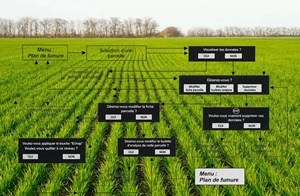
Morocco - a country on the southern shore of the Mediterranean - has farming systems heavily dependent on rainfall and irrigation water availability. Each climatic zone corresponds to a more or less specific system, characterized by a given level of productivity and its own fertilizer requirements. This close dependence between fertilization and water supply makes agroclimatic zoning a key structuring variable in the architecture and structure of decision-support software for optimizing fertilization. It was on this premise that the first Moroccan software dedicated to fertilizing field crops and forage was developed some thirty years ago. This user-friendly and comprehensive tool, developed in several modules, incorporates error checking and prevention of inappropriate choices during data entry, soil analysis interpretation, fertilization plan calculation, fertilizer selection, bulk blending formulation, and fertilization cost optimization. Furthermore, it features contextual "Help" sections, accessible at any time, explaining the purpose of each piece of information used and its limitations. It also offers fertilizer specialists the ability to adjust the suggested basic settings when they believe they have more suitable reference data. Designed to align with local agroclimatic realities, this software aims to be a readily accessible tool for farmers, regardless of their technical expertise: it provides fertilization plans based on soil analysis when available, as well as a "better than nothing" approach to initial fertilization in cases of incomplete or completely unavailable analysis. As the software has since been lost and its design was never published, this article aims to present its methodological approach to the agricultural community and, above all, to inspire initiatives wishing to revisit this major project with a fresh perspective, drawing on the latest databases and advances in artificial intelligence.
Keywords: Decision-support software, fertilization, field crops, farming systems, soil analysis, Morocco